Menu

Retail Store Water Cleanup in Portland – Minimize Downtime and Protect Revenue

When water invades your retail space, every hour of closure costs money. Our commercial-grade retail store water cleanup eliminates standing water, prevents inventory loss, and restores operations fast.

Slider Image 1
Slider Image 2
Slider Image 3
Slider Image 4
Slider Image 5
Slider Image 7
Slider Image 8
Slider Image 9
Slider Image 10
Slider Image 11

Portland Retail Flooding: Why Speed Determines Your Bottom Line

A burst pipe in the ceiling, a failed HVAC condensate drain, or a roof leak during Portland's winter rain season can flood your retail floor in minutes. When water spreads across high-traffic areas near the Pearl District or Lloyd District, the clock starts on three simultaneous threats: inventory damage, structural deterioration, and revenue loss.

Portland's maritime climate creates persistent moisture that accelerates secondary damage. Within 48 hours, water wicks into drywall, saturates subfloors, and begins fostering microbial growth behind display fixtures. Hardwood flooring common in historic Eastside storefronts swells and cups. Carpeted areas trap moisture against concrete slabs, creating liability risks and odor problems that drive customers away.

Commercial retail water extraction requires industrial-capacity equipment that most residential restoration companies lack. You need truck-mounted extractors capable of removing hundreds of gallons per hour, not portable shop vacuums. Store flood cleanup services must address contamination from street-level drains, especially in Old Town areas where aging infrastructure creates backflow risks during heavy rain events.

The real cost is not the water itself. Every day your doors stay closed, you lose foot traffic to competitors, miss seasonal sales windows, and risk losing lease compliance. Retail water damage restoration demands a different approach than residential work. You need technicians who understand point-of-sale systems, refrigeration units, and the logistical complexity of protecting merchandise while extracting water. Shop water damage mitigation starts with triage: what can be saved, what must be disposed of, and how quickly can you reopen.

In Portland's competitive retail environment, downtime is not an option. Water does not wait for business hours, and neither should your restoration response.

Portland Retail Flooding: Why Speed Determines Your Bottom Line
Commercial-Grade Extraction: How We Remove Water Without Destroying Your Space

Commercial-Grade Extraction: How We Remove Water Without Destroying Your Space

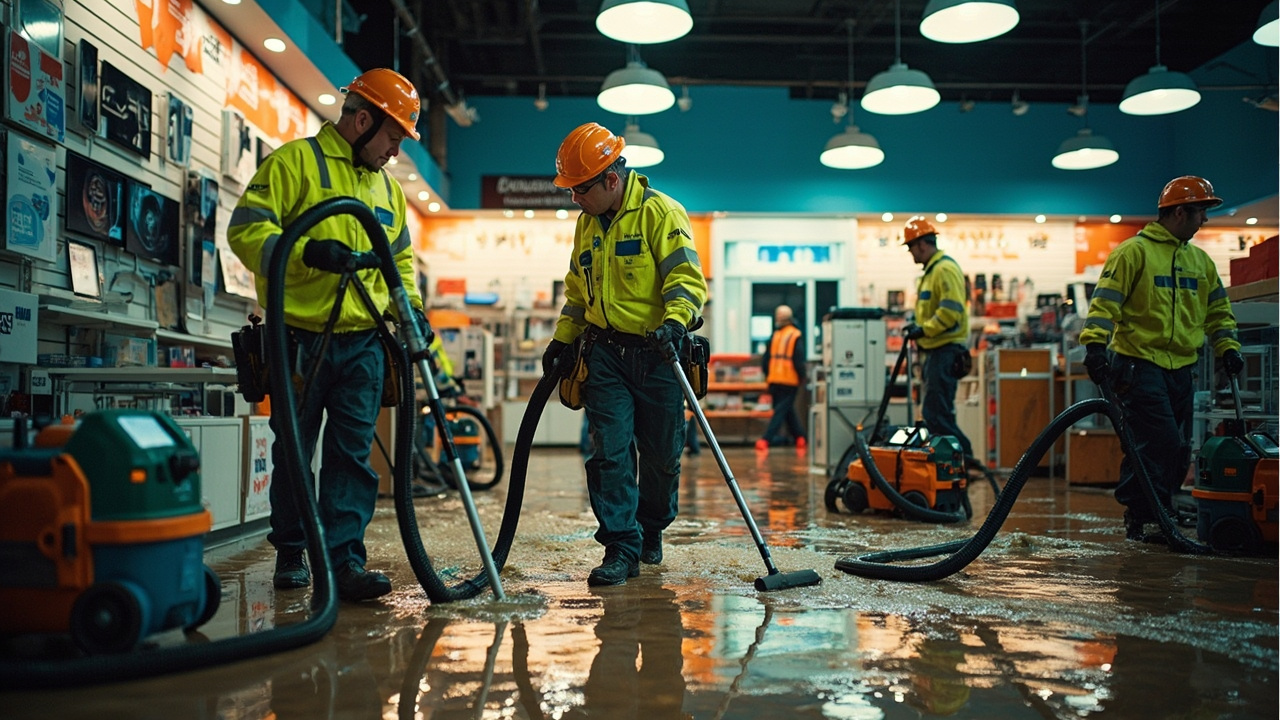
Retail water remediation begins with containment barriers that isolate affected zones while keeping unaffected areas operational. We deploy polyethylene sheeting and temporary walls to section off the damage, allowing you to keep portions of the store open if possible. This matters when you have undamaged inventory or seasonal obligations.

Our truck-mounted extraction units generate 500+ cubic feet per minute of airflow, pulling water directly from carpets, tile grout lines, and below-grade spaces. For Portland retail locations with raised wooden subfloors common in structures built before 1970, we use injectidry systems that force heated air beneath flooring without demolition. This preserves your buildout and cuts restoration time by days.

Moisture mapping using thermal imaging identifies hidden saturation in wall cavities and behind millwork. Water travels along the path of least resistance, which means a ceiling leak near your stockroom can migrate laterally through insulation and appear 20 feet away. We document moisture levels with non-invasive meters, creating a drying plan based on material science, not guesswork.

Dehumidification is not optional in Portland. Our commercial dehumidifiers remove 150+ pints per day, cycling air exchanges every two hours to prevent secondary damage. We monitor dew point and vapor pressure, adjusting equipment placement as materials dry. This is critical for retail spaces with HVAC systems that recirculate air, spreading humidity throughout the building.

We coordinate with your property manager, landlord, and insurance adjuster simultaneously. Most retail leases require immediate notification of water events. We document the loss in real time, providing photo evidence, moisture readings, and equipment logs that support your claim. Retail water damage restoration is about protecting your business relationship as much as your physical assets. You get a single point of contact who understands commercial timelines, not a rotating crew of technicians.

What Happens During Store Flood Cleanup

Retail Store Water Cleanup in Portland – Minimize Downtime and Protect Revenue
01

Emergency Water Extraction

We arrive with truck-mounted extractors and portable pumps to remove standing water from sales floors, stockrooms, and customer areas. Priority goes to electrical hazards and high-value inventory zones. We extract water from carpet backing, tile grout, and subfloor cavities using weighted wands and floor mat systems. The goal is zero standing water within the first four hours, preventing wicking and secondary saturation.
02

Structural Drying and Monitoring

Industrial air movers and dehumidifiers run 24/7, positioned based on airflow modeling and material density. We monitor moisture levels in walls, floors, and fixtures twice daily using penetrating and non-invasive meters. Drying typically takes three to five days depending on saturation depth and material type. You receive daily updates showing drying progress with quantified moisture readings, not subjective assessments. This data satisfies insurance requirements and lease obligations.
03

Clearance and Reopening

Once moisture levels return to baseline, we conduct final thermal scans to confirm no hidden pockets remain. All equipment is removed, affected areas are cleaned, and we provide written clearance documentation showing your space meets industry drying standards. If reconstruction is needed, we coordinate with licensed contractors familiar with Portland commercial codes. You get a certificate of completion that protects you from future liability and satisfies lease requirements.

Why Portland Retailers Trust Us for Water Emergencies

Retail water damage in Portland demands familiarity with the city's unique building stock. Storefronts along Hawthorne Boulevard and Mississippi Avenue occupy structures built between 1900 and 1950, with wooden subfloors, plaster walls, and minimal vapor barriers. These materials absorb water differently than modern construction, requiring tailored drying protocols.

We understand Portland's commercial building codes, particularly Title 24 energy efficiency requirements that affect HVAC modifications during drying. If your space requires temporary ventilation or supplemental heating, we coordinate permits and inspections to keep you compliant. This matters when your lease mandates adherence to city ordinances.

Our response time averages under 90 minutes for Portland metro locations. We maintain staging equipment in Southeast and Northwest Portland, cutting mobilization delays that cost you hours. When a pipe bursts at 3 a.m., you need extraction starting before dawn, not a callback promising a crew "sometime tomorrow."

We work directly with commercial insurance carriers familiar with Portland retail claims. This includes coordination with adjusters from major carriers who handle policies for shopping districts in the Pearl, Lloyd Center, and Bridgeport Village areas. You get documentation formatted for commercial claim requirements, not residential templates that delay approval.

Evergreen Water Damage Restoration Portland employs IICRC-certified technicians trained in commercial water loss procedures. We carry general liability coverage that meets commercial lease requirements, typically $2 million minimum. You receive certificates of insurance within hours if your landlord or property manager requests them.

Our equipment capacity matches retail-scale losses. We deploy 50+ air movers and industrial dehumidifiers simultaneously if needed, not the six-unit residential setup. For large footprint stores exceeding 10,000 square feet, we bring trailer-mounted desiccant dehumidifiers that process 2,000+ cubic feet per minute. Speed and capacity determine whether you reopen in days or weeks.

What to Expect During Retail Store Water Cleanup

Rapid Commercial Response

We dispatch crews 24/7, arriving at Portland retail locations within 90 minutes of your call. Our trucks carry commercial extraction equipment, industrial air movers, and documentation tools to start mitigation immediately. You speak directly with a project manager who stays on site during initial extraction, not a call center. For multi-location retailers, we coordinate simultaneous response across Portland metro if flooding affects multiple stores. Speed determines salvageability of inventory, flooring, and fixtures. Every hour counts when you have a lease obligation to maintain operations.

Detailed Loss Documentation

We photograph and document the full scope of damage before touching anything. Moisture readings, thermal images, and detailed floor plans become part of your insurance claim package. For retail inventory losses, we coordinate with your accounting team to document affected SKUs and quantities. This matters for tax deductions and claim settlements. You receive daily progress reports showing moisture levels, equipment placement, and drying timelines. Insurance adjusters get the technical data they need to approve the claim without delay. We know what commercial carriers require because we work with them daily.

Complete Structural Drying

Retail spaces dry completely, not just "good enough." We use psychrometry to calculate moisture evaporation rates and adjust equipment until materials return to baseline. For Portland storefronts with concrete slab foundations, we verify moisture levels drop below 75% relative humidity to prevent adhesive failure if you have glue-down flooring. Wooden display fixtures, millwork, and structural framing receive individual attention. You get written certification that drying meets IICRC S500 standards, protecting you from future mold claims or lease disputes. Corners are not cut to speed timelines.

Post-Mitigation Coordination

If reconstruction is required, we connect you with licensed commercial contractors familiar with Portland retail buildouts. This includes coordinating with your architect, designer, or franchise specifications if you operate a branded store. We provide detailed scope documents showing what was removed, what needs replacement, and material specifications. For ongoing monitoring, we offer 30-day and 90-day follow-up inspections to verify no latent moisture issues develop. You get a single source for mitigation and rebuild coordination, eliminating the gap where projects stall while you search for contractors.

Frequently Asked Questions

You Have Questions,
We Have Answers

How much does water damage cleanup cost? +

Water damage cleanup costs for retail stores vary based on the extent of damage, square footage, and contamination level. Category 1 clean water incidents cost less than Category 3 sewage backups. Expect variables like flooring type, inventory loss, and structural drying needs to impact pricing. Portland's older commercial buildings often require additional mold remediation due to moisture penetration in wood framing. Emergency response costs more than scheduled service. Most commercial policies cover sudden water events but exclude gradual leaks. Request an on-site assessment to understand your specific cost drivers and prioritize business continuity over the lowest bid.

How to keep a retail store clean? +

Retail stores need daily sweeping, weekly mopping with pH-neutral cleaners, and quarterly deep cleaning for high-traffic zones. Focus on entryways where Portland rain and mud track in. Use walk-off mats and replace them regularly. Clean restrooms twice daily minimum. Dust shelving and product displays weekly. Polish glass doors and windows to maintain visibility. Train staff on spill protocols to prevent slip hazards and water stains. Schedule floor waxing quarterly. Portland's damp climate demands vigilant HVAC filter changes to control airborne dust and maintain indoor air quality, which protects both inventory and customer experience.

How to clean up large amounts of water? +

Large water volumes require industrial extraction equipment, not mop buckets. Use truck-mounted extractors or portable pumps rated for commercial flow rates. Remove standing water within the first 24 hours to prevent structural damage and mold colonization. Deploy air movers and dehumidifiers immediately after extraction to dry subflooring and drywall cavities. Portland's high humidity slows evaporation, so increase airflow and run dehumidifiers continuously. Document water levels and moisture readings for insurance. Move inventory to dry areas first. Do not attempt this with shop vacs. You need commercial-grade equipment and expertise to avoid secondary damage.

What is the average insurance payout for water damage? +

Average insurance payouts for commercial water damage range from several thousand to over $100,000 depending on claim scope. Payouts cover structural repairs, content replacement, business interruption losses, and remediation costs. Portland retailers face higher payouts when historic building materials require specialized restoration. Insurers evaluate cause, response time, and preventable damage. Document everything with photos, moisture readings, and vendor invoices. Claims adjusters reduce payouts when you delay mitigation or fail to prove loss. Policies vary on coverage limits for inventory spoilage and lost revenue. Review your policy's water damage exclusions before a loss occurs.

Does insurance pay for water restoration? +

Insurance pays for water restoration when damage results from sudden, accidental events like burst pipes, appliance failures, or roof leaks during storms. Policies exclude gradual damage from deferred maintenance or flooding without separate flood coverage. Commercial policies typically cover emergency extraction, structural drying, mold remediation, and content restoration. Portland retailers must prove timely mitigation to avoid claim denial for secondary damage. Submit detailed invoices and moisture documentation. Insurers may require competitive bids. Review your policy for sub-limits on specific losses like spoiled inventory or business interruption. File claims immediately after discovering water intrusion.

How long does it take to clean up water damage? +

Water damage cleanup takes 3 to 7 days for minor incidents and 2 to 4 weeks for major structural drying. Timeline depends on water category, material saturation levels, and humidity control. Portland's wet climate extends drying times compared to arid regions. Category 3 contamination requires longer due to sanitization protocols. Extraction occurs within hours, but drying hidden cavities in walls and subfloors takes days. Delaying response adds weeks to the timeline and increases mold risk. Plan for partial store closures during active drying. Fast response minimizes downtime and lost revenue, which matters more than speed alone.

Is $50 an hour for cleaning good? +

For standard janitorial work, $50 per hour falls within Portland's commercial cleaning rates. Specialized water damage restoration costs significantly more due to equipment, expertise, and emergency response requirements. Water extraction, structural drying, and contamination remediation require certified technicians with industrial tools. Compare scope, not hourly rates. Cheap labor misses hidden moisture and creates long-term mold liability. For retail stores, prioritize vendors with commercial experience, proper insurance, and documented training. Portland's liability environment means cutting corners on water cleanup exposes you to tenant claims, health code violations, and insurance disputes. Pay for competence.

What are the 7 P's of retail? +

The 7 P's of retail are product, price, place, promotion, people, process, and physical evidence. For water damage contexts, physical evidence matters most. Stained ceilings, warped floors, and musty odors destroy customer confidence and reduce dwell time. Portland shoppers expect clean, dry environments year-round despite the rain. Water intrusion disrupts process by forcing inventory relocation and limiting floor space. It affects people through health concerns and safety hazards. Protect your retail investment by addressing water damage immediately. Your store's physical condition directly influences purchasing decisions and repeat traffic.

What is the 80/20 rule for cleaning? +

The 80/20 rule states that 80% of results come from 20% of effort. For cleaning, focus on high-impact zones like entryways, restrooms, and checkout counters where customers notice cleanliness most. In water damage scenarios, 20% of quick response prevents 80% of long-term damage. Extracting water in the first 24 hours stops mold growth, structural decay, and inventory loss. Portland retailers should prioritize visible customer areas and moisture-prone zones near plumbing and exterior walls. Concentrate mitigation resources on critical infrastructure first, then address secondary spaces. Efficiency matters when minimizing business interruption costs.

What are the 7 steps to clean water? +

The 7 steps to clean water restoration are assessment, water extraction, debris removal, cleaning and sanitizing, drying and dehumidification, monitoring moisture levels, and final restoration. Start with identifying the water source and shutting it off. Extract standing water using truck-mounted pumps. Remove damaged materials that cannot be salvaged. Clean all affected surfaces with antimicrobial agents. Deploy air movers and commercial dehumidifiers. Monitor moisture daily with meters until readings reach dry standards. Complete repairs and return the space to pre-loss condition. Portland's humidity requires extended drying times and vigilant monitoring to prevent mold in wall cavities.

Why Portland's Wet Season Elevates Retail Water Damage Risk

Portland receives 36 inches of rain annually, with 75% falling between October and March. This creates sustained roof saturation, particularly for flat or low-slope commercial roofs common in retail strips along 82nd Avenue and Powell Boulevard. Aging roof membranes develop pinholes and seam failures that allow water to pool above drop ceilings, eventually collapsing tiles and flooding sales floors. The Willamette River's proximity to downtown retail districts raises groundwater levels during winter, increasing hydrostatic pressure against basement stockrooms and below-grade spaces. Retail water damage restoration in Portland must account for continuous moisture exposure, not isolated events. One storm does not cause the problem. The cumulative effect of months of rain does.

Portland's commercial building inventory includes significant pre-1980 construction, particularly in established retail corridors like Sellwood, Belmont, and Alberta. These structures lack modern waterproofing and often have cast iron drain systems prone to corrosion and blockage. Store flood cleanup services require understanding how these older systems fail. We work with property management companies and commercial landlords throughout Portland who trust us to protect their tenant relationships and property values. Our familiarity with local building inspectors and code enforcement streamlines permit approvals when reconstruction involves plumbing or structural modifications. Choosing a local commercial restoration company means working with technicians who know your building type and your neighborhood's infrastructure challenges.
Water Damage Restoration Services in The Portland Area

Evergreen Water Damage Restoration proudly serves Portland and the surrounding areas, providing rapid and reliable water damage solutions whenever you need us. While our physical office is located conveniently for local operations, our dedicated teams are mobile and ready to deploy across the region. View our service area on the map to understand our reach, or simply call us to confirm if we cover your specific location. We are committed to extending our expert services to every community in need.

Address:
Evergreen Water Damage Restoration Portland, 239 NW 13th Ave, Portland, OR, 97209

Additional Services We Offer

Our news updates

Latest Articles & News from The Blogs

What happens when a well pump or pressure tank leaks in your Mapleton garage When a well pump or pressure…

What happens when a well pump or pressure tank leaks in your Mapleton garage

What happens when a well pump or pressure tank leaks in your Mapleton garage When a well pump or pressure…

Dealing with lead and asbestos during water damage repairs in older Portland neighborhoods

Dealing with lead and asbestos during water damage repairs in older Portland neighborhoods Portland's historic neighborhoods face unique challenges when…

Why converting your University Park basement into a bedroom requires extra moisture protection

Why converting your University Park basement into a bedroom requires extra moisture protection Portland’s University Park neighborhood, nestled near the…

Contact Us

Water does not wait for convenient hours. Call (503) 882-7766 now for immediate retail water extraction. Our crews are standing by with commercial-grade equipment ready to deploy across Portland metro. Minimize downtime and protect your revenue.